
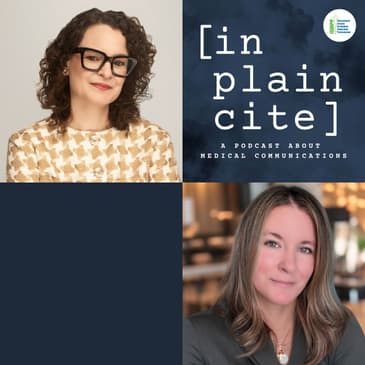
Today on In Plain Cite, we explore the integration of social media into medical communication strategies, addressing how social media serves as an "additional channel" in publication planning, enabling the rapid dissemination of critical scientific data to healthcare professionals.
Our guests, Leslie Rotz of Fingerpaint Medical and Amanda Solis of Pfizer, also discuss some of the challenges of social media, including managing the increasing volume of medical information and stringent compliance concerns.
Listen to gain practical insights into the organizational "who" of social media, from dedicated omnichannel teams to leveraging corporate channels or empowering authors. For those looking to start social media efforts, our guests outline a stepwise approach emphasizing audience insights, strong compliance partnerships, and conducting baseline assessments.
To join ISMPP, visit our website at https://www.ismpp.org/
Rob: Social media has transformed how we consume news, entertainment, and even science. But in the world of medical communications, it raises tough questions. How do you balance speed with accuracy? How do you decide what to communicate? And for teams just getting started, where do you even begin?
This is In Plain Cite, a podcast exploring the biggest questions and trends facing medical publication and communication professionals. I'm your host, Rob Matheis, President and CEO of ISMPP.
On today's panel, we're joined by Amanda Solis, most recently Digital Medical Engagement Team Lead at Pfizer and Leslie Rotz, Managing Director of Insights and Connections at Fingerpaint Medical. Together we'll dive into how social media is changing publication strategy, what compliance guardrails look like in practice, and how medical teams can take their first steps with confidence.
Rob: Back in the day, we would've thought about overall publication planning and probably never even considered anything like social media and I'm just, I'm just wondering how it came to be that social media is actually a part of our strategy now and maybe some thoughts on what it brings to the table. Amanda, why don't we start with you.
Amanda: Yeah, we have to consider the pace we're all living in, right? We are reaching medical professionals, healthcare professionals with our messaging and the important news about publications and the latest data in science. And that world is much broader than just that messaging. We all pick up our phones probably much too early in our day and wake up wanting to know what's happening at our fingertips. And we have to, I think, recognize that those we're wanting to reach, healthcare practitioners, by and large, are living in that world. They're not excluded in how they want their information. And so we've had to join that and recognize that putting information at people's fingertips certainly does necessitate the use of social media and it's grown in, especially in the last year or two.
Rob: It's interesting too that you say that because when you think about pace, publications are probably some of the slowest types of deliverables you can possibly have, and yet social media, you can push a button and have medical information out in someone's hands within seconds, which literally can quadruple the amount of volume of information that's available.
Amanda: Yeah, the volume adds a layer of complexity because it becomes very crowded. That's the other consideration we have to make. I think in the past we were faced with competing channels, if you will, from other medical information sources. In the publication space that was largely print, maybe, for a very long time, very set, a very set mechanism, a very time-dependent, conference-dependent kind of set or calendar, if you will. And now I think one of the things we've had to recognize is we're in this massive space and landscape, not just for medical information, but even with non-medical publications and dare I say, that kind of commercial messaging and space as well, where people aren't, not always able to discern the type of message that we're talking about.
Rob: Leslie, do you have additional thoughts on that? We're literally adding much more information for people to sort through. From an agency perspective, what are your thoughts on that?
Leslie: Yeah, so we could be adding much more information or we could think of this, uh, as it relates back to that channel mix. So just because we have these plethora of options available to us doesn't necessarily mean we need to leverage every single one of them for every single piece of content and every single message, right?
So it's aligning our communication objectives, what we are trying to change as far as perceptions or behaviors or understandings with those HCP to the appropriate channel to disseminate that on. So the answer might be social media in some cases, but I'd venture to guess that it's not the answer in all cases.
Rob: Okay, so I was gonna wait on this topic, Leslie, but you brought us right there very skillfully. So then how do we know which times we want to, say tweet something or use social media versus others? And on top of that, how do we make sure we're not cherry-picking, like making sure that we're just putting out messages around things that are positive versus things that could not be consistent with what we wanna put out there.
Amanda: Gosh, I have to say you activated something by saying cherry-picking. That's a term we talked about quite often in terms of social media, trying to determine and decipher guidelines and parameters around that exactly, because the goal is to abide by very stringent standards with, you know, compliance and that, that's challenging. We would have a lot of internal dialogue and debate around just that. How do we determine and decide when we're gonna do all or nothing? And where I was, where I spent my last few years, it was taking that ‘all’ approach. We had strict guidance around if you're going to talk about or tweet or post or do any kind of social media around a conference, an abstract, let's say, then you need to talk about all of them, or at least list all of them. And then that cues a significant amount of work and coordination that has to happen, especially if you're talking about a congress or conference that is gonna happen across five different teams, let's say. There's a very careful balance there. Certainly don't have the answer to it, but talk about, talk about challenges, and opportunities, of course.
Rob: So just to double click on that for a second, for our listeners. So are you saying that in your previous experience, like everything was tweeted for a particular con, like every piece of data?
Amanda: Yes, so the way we handle that, and I'll just take the obvious conference or congress, ASCO, right? We could potentially have had 40, 40 to 50 abstracts. The work then was decided that they all had to be listed. If you're gonna talk about one, even if you're gonna do a deeper dive perhaps, or feature a late breaker, let's say, you still need to include in the total number that, and I'll just say Pfizer has X number of abstracts at ASCO, as an example. And so the way we would do that is through like a carousel on LinkedIn as an example. And you would move through either a list, or at least have the total number represented. And again, the work it took across the entire enterprise to gather that intelligence and even get the number right, the numbers could fluctuate and really impact your planning and the coordination it took to, to do that.
But yeah, cherry-picking, oh, you sent my little like alarm bells off there.
Rob: I might have done that for our listeners too. So that's why I wanted to dive into that a bit, and we'll get to Leslie in one second. I want to ask you one more question though, Amanda, on this topic, which is, do you also do the same or had you also done the same for publications themselves, not just abstracts, but everything in your strategic publication plan, would that also get some visibility on social media?
Amanda: Yes, actually that is the case. It was an all or nothing, and that's something we developed as a standard and parameter. I will say there's a caveat that the rule and the governance was a little more flexible when it came to things that were clinical in nature, or let's say like phase three, and especially in that oncology space because of the nature of that business.
Rob: Leslie, what are you seeing on your side from these perspectives around this issue of just making sure we're paying attention to what's actually being put out in social media? And is it inclusive, is it not inclusive across your experiences?
Leslie: Yeah, so the standard that Amanda describes, I've definitely observed with multiple organizations.
So this idea of if we're gonna communicate anything, we have to communicate everything, which kind of speaks to your earlier point of information overload, right? It's probably not from a channel strategy, the optimal way to go about things, but from a compliance perspective, it is. Where I've seen that help for pubs teams, for broader medical affairs teams is in those compliance conversations when you're trying to gain approval for a novel channel or a medically driven or medically led channel. Because in reality, the teams that traditionally are going to be communicating about things like publications, it's probably gonna be your corporate team that's putting out a press release, which is really helpful for investors and other audiences, but it's not exactly what the HCP wants to read. But I can also almost guarantee you that they're not putting out a press release about every single publication. So therein lies that compliance conversation of, Hey folks, we actually want to be more compliant. We don't want to appear like we're cherry-picking. If you put medical or pubs in charge of leading this initiative, we'll ensure that all of our work is being displayed and not just the ones that align with the corporate audience, the corporate narrative and so on.
Rob: Yeah, I think that makes a lot of sense. You also then lead me into another line of questioning though around, I guess the who of the social media. So you know, in your experiences across different organizations, Leslie, is it the companies that are actually using the social media channels or their handle or are they working through the authors, the author byline?
Leslie: So there are multiple organizations where the remit of social media is a bit unknown. Some organizations benefit from having an omnichannel team or a channel excellence team, and they are aligned with the responsibilities of taking on social media, taking on third party, and owning that.
A lot of organizations, and this was a bit of a learning for me, do not have that. So it becomes this question of is, if the pharma company is going to do that, who is that going to lie with? So sometimes that's challenge number one.
I think there are multiple ways to half step into this. So collaborating with your corporate colleagues is certainly one. So if they have channels that they own, are there ways that we can begin disseminating medical content on those corporate channels if we can't launch a medical one? Absolutely, and you can work through ways of working and how you help editorial plan the calendar, et cetera. Other ways is definitely partnering with the car-, the authors or the journals, if that's an offering that they have. Not even so far as to go into co-creating content, but just for authors, making sure that they feel empowered to do that. Obviously their audience is also the audience that we're trying to get to, and HCPs like to hear from their peers, so there's a lot of value in what, that would be categorized as not even traditional KOL engagement, but DOL engagement and how you can leverage those folks and their influence online.
Rob: Yeah, that's a whole other podcast for us, is talking about the the DOL concerns there and how that can work. But for now, I want to try to jump into, let's say, I’m one of our listeners, and they're not using social media at all right now, and they wanna dive into it. They've heard this podcast and they're interested. What would be your recommendation for how they get started day one back in the office, and what channels should they be using and what's the simplest way to get, to get going? Leslie, we'll start with you on that one.
Leslie: Stepwise approach. Um, so starting with audience insights, it's probably easy to go out there and figure, well, there's a lot of benchmark examples on LinkedIn and X, so maybe that's where I should go. But if you know more data or have more data about your audience, your specialties that you're trying to reach, whether it be syndicated research or behavioral data, that allows you to roadmap those channels more strategically, and we know the foundation of everything we do is strategic planning.
In addition to that, it will likely require partnering with compliance and certainly understanding the uh, path that others within your organization have already ventured down. So whether that be your colleagues in corporate. It could even be, frankly, your colleagues in commercial and the types of channels that they've gotten approved, and the learnings they have from those concept reviews. I think there's a lot of value in exchanging knowledge and putting you in a position where you can attack this type of initiative in a way that is backed by your own internal research as well as your audience research.
Rob: Yeah, so the stepwise approach definitely makes sense to me, and I can see how that could be put into place. Amanda, what's your experience been in terms of how someone might get started from an industry perspective?
Amanda: Absolutely. First of all, expect to be 100% overwhelmed. I had an amazing, amazing opportunity in my last role to lead and build a team focusing on all of this, social media, digital engagement. And I, hopefully it's a safe space to say that, was completely in over my head in the beginning. Um, one, don't be afraid to ask questions, right. Go find wonderful external, but internal partners as well. One of the things you know, I was a little leery of was, gosh, when I go meet with my commercial counterparts, who we had to partner with because we needed to follow their standards and guidelines, I felt a little leery of admitting what I didn't know, but they were very open and welcoming and truly helped us. Now, you know, there's a push and pull, of course, that's gonna be there. But one of the things we did in the very beginning was to do an assessment. I figured someone's gonna ask me in six months what we had accomplished. So we needed to start with a baseline, and that baseline became incredibly important. What are we doing today? What channels are we using? How are those channels performing? Who are we reaching? And then that allowed us to do that kind of landscape assessment that we could show our leadership, and then use that landscape assessment to chart our course forward. And our own goals and objectives were 6, 9, 12 months down the road.
Rob: There are definitely reasonable approaches to get involved. Do either of you have advice if, let's say someone is in a small company and they are [inaudible] of one, and they're doing five different jobs and sweeping the floors at night and they really don't have the budget or the time to put into a stepwise plan even, at the very least, what would be the channel you'd recommend that they use? Like which social media outlet?
Leslie: Let's see. So I would go back to the reality that sometimes taking that half step is going to be what makes sense for an individual. These smaller organizations that don't have the discrete teams for which social media is a responsibility, you might have to leverage what is there within your organization already. In a lot of cases that is corporate. I think if you show an interest in helping corporate with the dissemination of medical content, even through their channels, they will likely surprise you in how receptive they are to that and helping them build a strategy that's more holistic to your pubs plan or a broader medical communications plan. I think tearing down some of those walls is thematically something we're seeing across the industry, and certainly could come into play here if it's an individual who, to your point, Rob, doesn't have the time, budget, or expertise to do it themselves.
As far as a channel that I would recommend, this is a huge generalization, and I'm gonna say it's maybe something that's cross specialty, but there's a lot that we're seeing across the industry as it pertains to X and the level of comfort in staying there for both brand safety reasons as, as well as other things. We aren't seeing that same sort of hesitation on platforms such as LinkedIn. We know that many HCPs go there for professional purposes. Obviously, professional purposes can mean a lot of things, including networking and finding jobs and so on. But if you were to ask me to zone in on one, that would be the one.
Rob: Interesting, yeah. Um, is that your go-to social media or be some other channel?
Amanda: We, we definitely did a lot on LinkedIn and I would say LinkedIn is a nice place for pilots, if you will, because there are actually a number of different things you can try and test and then assess with an individual campaign level to understand your campaign kind of reaction and metrics. So LinkedIn from a metrics standpoint, gave us a lot of data to assess. We had, uh, where I was previously two different medical affairs LinkedIn channels. And so we could do a comparison there with those two different channels, but we could also compare organic versus paid. And there was a lot that we could see with paid posts versus organic posts, which really showed a solid bang for your book investment wise. So that was one of my favorite things to show those colleagues that were hesitant. And LinkedIn again gave you a lot of rich metrics and data points that we could use to say, Hey, you don't know if you wanna do this, you're not sure about social media? Give us a small $5,000 budget amount and we can do a quick pilot for your message, your post, and then run it for two weeks, three weeks or so, and show a pre-post. I could then give teams incredibly solid data to react to, and show them this post was organic, this post was paid, and for your investment here is how many clicks, how many people went to maybe the med, med affairs website, and they went where you directed them, so and so forth.
And so for me internally from that kind of pharma, internal corporate perspective, getting people to convert that was incredibly resourceful.
Rob: Yeah. And that's a perfect segue right into one of the additional topics I wanted to get into, which is you might have convinced me that we can get a lot of information out there quickly, and we can use a lot of channels and we could probably find a compliant way to do it, but now you've gotta convince our listeners that they should be actually doing this and what the return might be on that. So for that 5,000 bucks, what did you think you were getting out of, out of that investment, Amanda?
Amanda: Yeah, it's fascinating. Honestly, it was incredibly fascinating to see. You could see the titles of the intended audience who clicked on it or took any kind of action or, and or visited this site. And so you would get this wonderful report of the HCPs or whomever your intended audience was, what their titles were, their location, so on and so forth. And again, all of that is based on the work you did in advance to, to put together your target audience. So you, everything is very controlled when you're doing paid, and that's one of my other kind of favorite reasons for doing more with paid media, even though I think on the medical side, we've always gasped a little bit about how promotional that feels. We had a lot of internal dialogue and conversations about that so we could see who we reached how. And then there was the opportunity to tweak your target audience, so we could continue to build.
The other wonderful thing that we learned how to do was to have these follower campaigns. So if your intent was to have a single message and time. Maybe it was a publication you wanted to spread word about, but also if you wanted, you knew you were gonna have five to six other posts throughout the next period of time, six months, let's say, you might wanna accrue your followers and engage them. So there's just a number of different ways that we could utilize LinkedIn in order to try to one, accrue an audience or two, do specific targeting. And then you could…those who took action and clicked or engaged with it in some way, stayed within your network and stayed and almost became a part of that audience and they weren't ingrained, if you will, there's a lot that you can try and test and tweak on your own. And I won't, I'm not gonna take full credit for this. Someone that is still on the team really enjoyed digging into those experiments and, and I give her all the credit for kind of running these experiments.
Rob: So would you say, Amanda, that given all that you've discussed around metrics, that social media is actually having an impact on healthcare. Are patients getting better treatment because we have social media today?
Amanda: I do believe so. Because again, that timeliness of information. The timeliness of information truly matters. And if you look at some of the work that's being done, and some of the teams that have really tiny budgets. Take rare disease, for an example. Rare disease, they have, depending on, you know, the therapeutic area, they have very specific inset audience and it might be a very tiny audience. So the channel exploration allows you to do a deep dive and understand where are they. One of the interesting things we learned throughout all the work that was done, the landscape analysis, was there's a difference by channel. Certain clinicians have preferred channels. So when you're talking about targeting 3000 nephrologists. I don't know how many there are, I made that number up. But if there are only 3000 nephrologists, let's say, and you need to reach them with your message, and it's about a key piece of data that just came out, you need to understand where they are. You can't just, and also you don't have the budget to blast that message out to everyone.
I do. I very much actually believe that social media helps to get that message out, specifically in a targeted manner. But it certainly takes work to do it correctly.
Rob: Leslie, same question. Do you believe that people are getting better healthcare because of social media?
Leslie: You're asking that attribution question that is so hard to answer, right? So social media is one channel. We talked about that channel mix, that's not just a mix of social channels. It's really we're talking about categorically, your owned, your paid, your earned. There are many pieces of content that are being put out into the ecosystem that all have a role to play. Social media has a role to play in that.
The metrics we get from social media are tactical, right. Just like any of your other channels, you're gonna understand impressions, engagements, things of that nature. Are there high value actions that have been taken on the site that you're sending them to and so on. You get that tactical information from your other channels too. All of that layers up to changing perceptions. All of that layers up to changing beliefs. And those types of things can only be measured through things like pulse surveys, before-afters, a bit of social listening, ad boards and so on.
What we learned from social is specific to the role that social was supposed to play. Now, one of the things that I encourage is that each singular post have its own mini objective, meaning we might be trying an awareness play with a certain message, whereas we might be trying a engagement play with another message depending on what we want that HCP to get out of that information or to do. Therefore, when we're trying to measure success of an initiative, it's not so straightforward as to say, well, impressions are the most important, or engagement rate is the most important. It really depends on the individual objective of that one post. So it's something that I encourage my team to do often that we actually get. We pull ourselves out of the data and looking at the benchmarks or what we think looks good or what is successful, and actually look at the content of the posts and what we were trying to accomplish.
It's interesting because I think the metrics that matter, I don't think, I know the metrics that matter are going to evolve. This is very relevant to social specifically because there is data that's showing us that these social platforms want to keep their users within the platform instead of sending them off. So even a lot of the examples that Amanda was just talking through, right? It was about sending them to the publication or sending them to the medical portal. The social platforms are user-centric platforms. If they think the user wants to stay there and not go elsewhere, they are going to adjust their algorithms so that organically, those are the types of posts that perhaps get the most engagement or are seen the most frequently and so on. So, not that we have done a wonderful job yet of defining metrics that matter to medical affairs and publications, but I can almost promise you that the direction we were headed in needs to take a little bit of a turn or a shift and not be so focused on eyes on a publication within the journal or traffic to a medical portal website, because it's not how users are finding information anymore, and it's certainly not how social platform algorithms are going to work.
Rob: Such an interesting conversation and one where, what strikes me as we're talking about all this, it's language that we would never have used a couple years ago. It's discussion points and strategic and tactical approaches that we would've never even thought were part of our medical communication plans. I guess as a final thought, when we think about all the different organizations that could be leading these efforts, what makes pubs the appropriate one to lead off?
Leslie: A question that I've seen come up from folks is, yes, I understand this is a, can be a medical led initiative, but there's a lot of departments within medical, what makes it so specific to pubs? And I like just the one-liner of a reminder of, the first medical X handle was launched with the singular objective of publication amplification. And it grew from there, but that's what it started with.
Rob: I enjoyed the conversation. It's been a while since I've been able to talk about social media in this kind of setting, so that was cool.
Leslie: Appreciate the opportunity. Thank you.
Amanda: Thank you.
Rob: Well, that's us for today. Thank you all for listening. Please take a minute to subscribe to In Plain Cite on your favorite podcast app. Share with your colleagues and rate our show highly if you like what you heard today.
In Plain Cite is a production of ISMPP, the International Society for Medical Publication Professionals.
Our production partner is CitizenRacecar. Our producer and editor is Hajar Eldaas. Post production by Alex Brouwer. Publication and promotion by Candice Chantalou.
To join ISMPP today, go to ismpp.org. Becoming a member means you can participate in value packed webinars and receive instant access to exclusive tools and resources. If you're interested, just go to ismpp.org, that's ISMPP.org, to learn more.