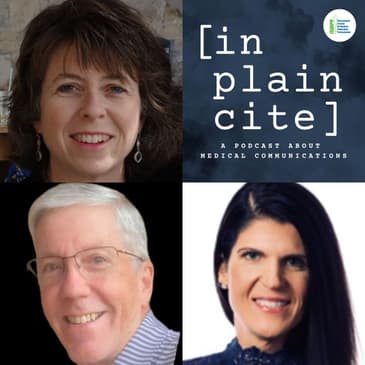
Overly complex medical information creates a barrier to effective patient care. In this episode, guest host Steve Palmisano, Executive Vice President of Publication Services at The Lockwood Group, leads a discussion with Danielle Grospitch, Scientific Director at The Lockwood Group, and Professor Cynthia Baur, Director of the Horowitz Center for Health Literacy. Together, they examine the challenges patients face when trying to understand medical content and highlight the power of plain language summaries in making that information more accessible.
To join ISMPP, visit our website at https://www.ismpp.org/
Rob: When patients struggle to understand medical information, the consequences can be profound. Yet too often, healthcare communication remains overly complex, leaving many feeling excluded from decisions about their own health. How can we change that?
This is In Plain Sight, a podcast exploring the biggest questions and trends facing medical publication and communication professionals. And for this special discussion, we have a guest host taking the reins. I'm excited to introduce Steve Palmisano, Executive Vice President of Publication Services at Lockwood.
Steve is joined by two incredible guests, Danielle Grospitch, Scientific Director and health literacy expert at Lockwood, and Professor Cynthia Baur, Director of the Horowitz Center for Health Literacy at the University of Maryland School of Public Health. Together, they'll explore what's missing from the current state of health literacy, why plain language summaries are essential, and the techniques that can make medical information truly accessible.
Now over to you, Steve.
Steve: Tell us about your roles and mission to improve health literacy. And maybe as a segue, I'll share what I recall you stating at the health literacy conference earlier this year: “Even the best science won't make a difference unless it is shared with others in ways they can understand and use. This is why we must recognize and address health literacy as both an asset and limitation for health communication.” Cynthia?
Cynthia: Thanks Steve. I'm very excited to be here with you and Danielle today to talk about a subject that's near and dear to my heart.
I've been doing this work for a long time. My training had been in communication and I hadn't actually been thinking about some of the provider-patient communication issues that were evident. Uh, but then I had my own personal experience. I got pregnant and I suddenly entered the maw of the medical care system and really sort of got put through the ringer. And that wasn't even really a difficult, uh, you know, pregnancy and delivery. It was pretty, you know, run of the mill standard stuff. But I still felt very overwhelmed, very just a wash in jargon and the whole medical experience. And I felt just very put off by it. And I thought there has to be a better way, like this cannot be the only way to get healthcare. And it certainly didn't feel patient centered at all. And I thought millions of people have had babies before and will continue to have babies, if it's like this for something as routine as having a baby, what's it like for everything else?
And that sort of set me on my path to say like, it's great to have evidence-based programs. It's great to really, um, bring the science, but at the end of the day, uh, a lot of this research is directed towards improving patient services, patient care, public health, you know, the way that we disseminate these recommendations into communities. And so to me, this is why health literacy is absolutely essential to the way we do public health and medicine, not just in this country, but everywhere.
Steve: Great, thanks Cynthia. Danielle?
Danielle: I became very interested in health literacy about, uh, it's probably been 18 years now. I worked in cancer research at the time and I had to take my mom to an appointment 'cause unfortunately she was diagnosed with pancreatic cancer. Due to my work in pancreatic cancer at the time, I was able to ask the radio oncologist if they had any recommendations for my mom, and so I took copious notes. And when I went to that appointment with her, I asked the questions that the radio oncologists that I worked with encouraged me to ask. The doctor leaned across the room and touched my knee and said, “What did you do? Google that?” And it made me so uncomfortable because here I am trying to advocate for my mom and give her the best opportunity for a good quality of life for whatever life she had left. And the doctor was basically diminishing our concerns not knowing where I came from, that I was doing research in cancer and, and that was something that I could actually speak to.
So we left the appointment rather abruptly, and I stood in the waiting room with my mom and I, I vowed to her at that time that I'll never let another patient go through what we went through, just when you're trying to advocate for your own health and wellness. I didn't know at the time that that was called health literacy, or it was the track for health literacy. But when I finally went on to get my master's in public health and was introduced to the concept of health literacy, that's when I truly fell in love and have been passionate about it ever since.
Steve: I know I've heard you talk about the word self-efficacy, so tell us a little bit more about what self-efficacy really means in the setting of plain language.
Danielle: One of the main goals of health literacy is that, is someone able to decode instructions, symbols, charts, and diagrams while weighing risks and benefits or making decisions to take action? Self-efficacy is defined as someone's confidence in how they'll be able to make well-informed decisions and properly advocate for their own health and wellness. Will they be able to actually use health information and not just understand it?
Steve: So, Cynthia, what do you think are the barriers to plain language writing?
Cynthia: Part of the barriers are in our training, right? So there's not enough training in plain language communication, in this audience centered approach and how it is that you draft and, uh, iteratively design and test these materials with the intended audience. We have people going into these roles that don't have the training to do this. They might have the subject matter expertise. They might be extremely knowledgeable about chronic disease or infectious disease or environmental health or drug development, or whatever the issue is. But they don't have the training in communication.
And then there's not the partnership, right? So I've worked in organizations where there were dedicated communications staff, but they were not always given that seat at the table, right? They were not part of that decision making process. So even if they drafted the materials in plain language, even if they did that audience testing, when those materials got further into the review process and the subject matter experts got their hands on them, then suddenly the jargon came back, the long sentences came back, you know, the indecipherable graphs came back. And so then it became sort of this real tussle over what was going to get reviewed and cleared and, uh, put out for public dissemination. So I think those are a couple of the, the key barriers.
I think also that, you know, this takes a little bit of time. So I've worked in organizations where the imperatives, we've gotta get something out, right? We've gotta get something on the website, you know, we've gotta get something in the press release. And we don't often think about the consequences if we put out things quickly, but that are not well understood or actionable. And I think if we take only one lesson from COVID, although there are many, many lessons from the COVID years, but if we take only one lesson from COVID, is that you can do great harm if you put out information that is not well understood by the public. And so I think we need to start thinking about those consequences when we communicate with materials, with products, with messages that are not well understood by the public. And I think that can really reorient these discussions around the misinformation problems. It's not gonna solve all of them, but I think a lot of it can be traced back to the fact that we leave a real vacuum when public agencies, when trusted sources, when people with that evidence are not communicating clearly. Other sources, other voices will step in and fill that void, and I think that's a really, really underestimated consequence of not communicating plainly.
Steve: I want to kind of bridge this into our next conversation with an article by Avishek Pal and others published in CMRO earlier in 2024 of which the author stated, and I'll read this, “Across all these dissemination channels, the language used in highly technical and formats of presenting complex data are text heavy and data dense. Consequently, such information does not meet the needs of a non-scientific audience, such as patients and their caregivers.” So Danielle and Cynthia, you're both experts in this area. So what are some things we should be mindful of? What are some things we can be doing as solutions to this ongoing challenge?
Danielle: One of the things that I do, and whenever I tackle writing something that's heavily scientific into something more plain language, is I become very familiar with disease state. I wanna make sure that I know the disease state in and out. Uh, I wanna read blogs that patients talk about. I wanna hear and see the words that they use to describe how they feel. I fully read and understand the article that I'm going to be rewriting. And then I summarize that article for a coworker and I just, I borrow people and try to find ways to make things a little more understandable, but I'm not yet at the point where I'm making it for plain language.
After I've summarized it for a coworker, I then go and identify possible analogies or ways to visualize data, and then from there I rewrite the summary with what I like to call living room language. I take that summary that I wrote for my coworker and I start pulling in that analogy or the data visualization that I identified, and I start coming up with ways to describe the health information that I want to disseminate to the lay person or to the public. And I want to find ways that they understand it, like I'm having a conversation with them. And then I borrow my children or my children's friends and even test it further and make sure that when I read my plain language summary or whatever article I'm trying to reduce the writing level for, I make sure that they understand it. And my children are 10 and eight, so I make sure that even at that level they can comprehend what I'm trying to convey from that heavy scientific article. And so far it's served me well to go through those steps.
Steve: Yeah, great. Cynthia, I wanna come your way in a second, but Danielle, tell us what your definition of living room language is?
Danielle: If I'm talking with my spouse or my children in the living room, I'm not trying to talk to them about cardiovascular disease. I might say heart disease. I would say things like the organ in your chest that makes your heart beat faster or slower when you're excited. And if I'm trying to explain it to my 8-year-old, I think of it that way. I think of how I would talk to someone if they were just sitting in my living room and we were watching a football game. I'm not gonna be very formal. I'm gonna use emotional gestures and, and conveyance in, in everything that I'm trying to, to talk about at that time.
Cynthia: Well, I think it's taking this audience centered perspective. So my focus is more public health than medicine most of the time. In public health, there's very few messages that really apply to everyone. And a few of them are related to things like the seasonal flu vaccine, you know, because there's a very large number of people who are in that recommendation. Or maybe something like having a ready go kit, you know, for emergency. But most other pieces of information are actually intended for a specific set of people. And by that I mean, you know, if we were talking about vaccination, for example, vaccinations are typically for a specific group of people and, like, let's say you're talking about childhood vaccination, right? Who's going to be the decision maker in that case? Well, it's gonna be the parents or the caregivers of the children who are getting those childhood vaccinations, so it's not even all parents and caregivers. So I'm a parent, but I have an adult child, so I'm not thinking about childhood vaccinations anymore. I thought about that 30 years ago, but not anymore, right. So I think it's really taking this audience centered approach and then thinking out from the audience, what is it they absolutely need to know to be able to complete the recommended action.
And so we, we drill, we train, we focus on two things, the main message and the call to action. I can build any health material if I can work with the subject matter experts to understand what they want the main message and the call to action to be. It's not failed me yet and I highly recommend it to others 'cause I think it's a very successful strategy if you can nail that main message and call to action, you can get very far with the rest of the plain language text.
Steve: And Cynthia, maybe a little bit further, I know you've talked about, you know, your role in helping educate healthcare practitioners in helping them be more simplified in their language. Is there anything more you wanna share in that area?
Cynthia: Well, for a long time, the working definition in the United States around health literacy had what many people felt was sort of a personal or individual focus. In Healthy People 2010, the, uh, group that developed that document, which has our national health goals and objectives, talked about what individuals can do in terms of health information seeking and processing of that information. And in the following iterations of Healthy People, we're now up to Healthy People 2030, it said, we're gonna split the health literacy concept into two parts, personal health literacy and organizational health literacy. And the self-efficacy piece or really, you know, people's confidence that they can understand and do what's required for a situation is more directly part of personal health literacy. 'cause again, that's that, what can an individual do when they're looking for information or trying to understand it or move toward the health decision. But it also is related to organizational health literacy because that's that responsibility on us as professionals to do what's necessary to enhance people's confidence.
I think it's difficult for most of us to be self-reflective about our communication. I put myself in that category, right? I always have to kind of pull that mirror up to myself as well. So I just want people to understand that I empathize with how challenging it is to say, take a step back and look at your own communication style. But one thing that I have done to kind of help people along that pathway is to ask them what are they really trying to do or accomplish by sharing that information with a patient or a caregiver or a family member or a consumer or a community, however they define their audience. And if you can get clinicians or researchers or scientists thinking about that ‘what do you want people to do’ then you can kind of coach them towards, okay, how do you want to say that in a way that's gonna be more helpful rather than less helpful? Because as, uh, Danielle said, if you talk about cardiovascular disease rather than heart disease, you're gonna lose some people. Or if you say hypertension instead of high blood pressure, you're gonna lose some people.
And so that goes back to what we talk about is that communication objective. I just try and get them focused on what their communication objective is and then help them see that plain language is gonna move them along that pathway towards that objective a lot faster, a lot more easily, and with greater effect.
Steve: And so you're both health literacy experts. I know that at the most recent ISMPP Academy meeting in November in Philadelphia, we had posed the question to the audience about who they believe these plain language summaries are truly for. Who is the intended audience for these plain language summaries? And the preponderance of respondents at the meeting stated that it's the lay individuals, patients and caregivers. But there's a growing number of individuals in the audience that felt that these plain language summaries could actually benefit healthcare practitioners. What do you both say about that, Danielle? Any thoughts?
Danielle: It's about making sure you’re talking to the person the way that they wanna be talked to. But also what's important to them, what do they care most about? So do they care about the name of the treatment that they could possibly go on? Or do they care about what the treatment does? So what are you focusing on in your research and what are you focusing on when you're writing a plain language summary or an outline for a healthcare provider is more about what's in it for the patient. So if you're able to conduct focus groups and find ways to find out what's important to them, that's a perfect way to go about it. Another thing that I like to do is go on blogs where patients talk about what's important to them, and then that's how I structure any of my plan language summaries or outlines for healthcare providers, really focusing on what matters to the patient because that's what's gonna propel them forward, give them the confidence and actually make them act upon whatever health information they've received.
Cynthia: Yeah. We get asked a lot of times to write talking, talking point documents for clinicians to talk about health topics with their patients. And that's for things as kind of bread and butter and diabetes, right? You know, diabetes is a very common condition in this country as well as, as what's called pre-diabetes, right? So there's a lot of clinicians who are in the position of having to “counsel” their patients about pre-diabetes or diabetes. And one of the things that we do is actually write plain language, talking points for clinicians about how to have those conversations. Because again, it's not just as simple as, you know, uh, a quick recommendation about, you know, changing your diet or adding more physical activity or, you know, monitoring this, that, or the other thing. It's really having that conversation about what the patient thinks is happening, what it is they need to do. And especially if they're trying to coach them towards enrolling in a diabetes prevention program or a diabetes self-management program, it becomes really important that the clinicians understand what those programs are about, what's involved, and they can be there helping their patients through that process. One of the things we found when we did focus groups with people with pre-diabetes was that they wanted their clinicians talking to them and cheering them on when they enrolled in a program. They said, oftentimes they'd say their clinician never even brought it up again. And these are, you know, if you're enrolled in a certified lifestyle change program, that's 12 months long. So you're probably, if you are in the so-called at-risk category, you're gonna see your clinician probably once or twice during that 12 month period. And, uh, patients were telling us their clinician never even brought it up again, never even asked them how it was going or, or what was going on. And patients wanna have those conversations so clinicians do need to be ready to have that conversation in everyday language with them.
Steve: And Cynthia, um, I know that we're speaking to the publication professional audience, uh, which I know Danielle and I are part of that. Um, you're, you're coming at this from an academic perspective, but you're also a health literacy expert. So what more might you advise our audience related to the use of a health literacy expert as we're creating these plain language documents?
Cynthia: Well, I think anybody who's in the publication business, you know, there's a sort of, can benefit from thinking about, you know, the health, uh, thinking about the health literacy issues and applying health literacy insights to the way they go about the work, right? So we've talked a lot about audience in this podcast. We've talked about some of the specific techniques that can be really helpful. And what a health literacy expert can kind of bring to that conversation, whether you have them sort of in-house like you do, or if you have them sort of on speed dial for, uh, as needed basis, is they can kind of bring that outside perspective about, you know, what eventually becomes insider talk. So there's a phrase called the culture of knowledge, and the culture of knowledge effect is when you are so inside a body of information or body of knowledge that you don't recognize that other people don't know what you know. And that happens in a lot of domains in life, right? And so I think a health literacy expert can be those outside eyes because anybody who's worked in a space, even professional communicators who've worked in the same space for a long time, start to sort of see the world from that perspective, even, you know, with all of the best intentions, they're part of that world and they start to think about whether, you know it's, you know, flu or diabetes or some genetic condition or whatever it is, they start to really understand that from the inside out. As Danielle was saying, you know, as a communicator you have to understand the topic well enough to communicate about it yourself, and you can sort of start to kind of be inside that world a little bit too much. And so the health literacy expert can be those outside eyes and just kind of refresh everyone's perspective, I think.
And like I said, you know, communicators, senior communicators often don't get invited to the decision making table. And I think if you have that health literacy expertise and you allow them into this, you know, conversations about, you know, what's actually gonna happen with this, this product, this publication, this website, whatever, whatever that information product is, you know it, it's also a precautionary thing. The last thing you want is to kind of put out something that people really misunderstand or misuse in ways that you didn't intend either. So that's kind of, again, one of those anticipated but often unanticipated consequences.
Steve: Yeah, I like that thought process, the culture of knowledge perspective. I think that's very informative and, and speaks volumes to our, our conversation here today. And certainly the idea of not reintroducing jargon, you know. Once we've simplified these plain language documents, making sure that the subject matter experts do not reintroduce that thought process and, and certainly the role of health literacy experts. And so with that, I want to thank, uh, both of you, Danielle and Cynthia. This has been a very interesting conversation, but we are out of time for today.
Rob: Well, that's us for today. Thank you all for listening. Please take a minute to subscribe to In Plain Cite on your favorite podcast app. Share with your colleagues and rate our show highly if you like what you heard today.
In Plain Cite is a production of ISMPP, the International Society for Medical Publication Professionals.
Our production partner is CitizenRacecar. Our producer and editor is Hajar Eldaas. Post production by Alex Brouwer. Publication and promotion by Candice Chantalou.
To join ISMPP today, go to ismpp.org. Becoming a member means you can participate in value packed webinars and receive instant access to exclusive tools and resources. If you're interested, just go to ismpp.org, that's I S M P P dot org, to learn more.